Pressure sensor correction
Calibration
An optional refinement for absolute pressure accuracy, using a correct reference elevation and a trustworthy independent local barometer reading.
What you need
Before adding a calibration point, make sure the phone is stationary at the stated reference elevation and obtain a current independent sea-level pressure / QNH / barometer reading from a trustworthy nearby source.
The independent pressure must not come from Marine Barometer itself.
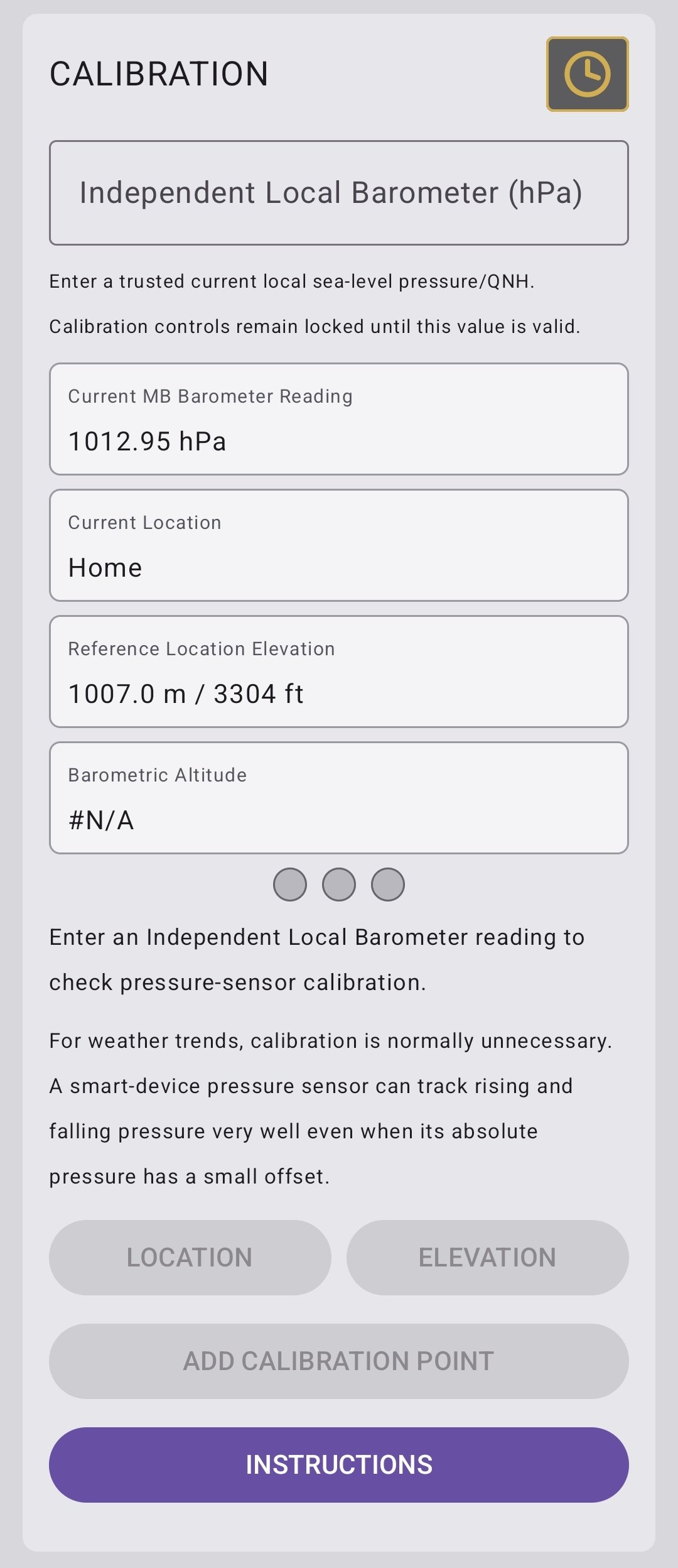
The five displayed values
- Independent Local Barometer — the trusted pressure value you enter.
- MB Barometer Reading — Marine Barometer's current reading before the new point is applied.
- Current Location — the location context for the check.
- Reference Location Elevation — the elevation used for the comparison.
- Barometric Altitude — altitude calculated from the phone sensor and the independent pressure reference.
Green, Amber and Red guidance
The Calibration Instrument compares Barometric Altitude with the Reference Location Elevation. Roughly speaking, Green is within 5 m / 15 ft, Amber is more than 5 m and up to about 10 m / 30 ft, and Red is more than about 10 m / 30 ft.
Green does not mean that another good calibration point is useless. Well-spaced observations at different pressures can improve evidence for a small sensor slope correction.
Reference elevation first
Calibration is only as good as the elevation and independent pressure used for that observation. If the elevation is wrong, the resulting calibration point can be badly misleading. Choose or verify the Barometer Reference Elevation before recording a point.
For a known elevation you can use Location, GPS or Manual Reference Elevation. If you use an outside map or survey source, enter that value manually.
How calibration evolves
A first good point can correct local offset. Marine Barometer retains deliberate calibration observations over time. Slope learning remains guarded until there is enough evidence: at least five usable observations, five distinct 1-mbar pressure levels and at least 20 mbar of accepted pressure span.
The model also uses outlier rejection, same-session repeat handling and limits on how quickly the learned slope can change.
Practical advice
Use stable conditions and good reference information. Small differences can come from the reference station's distance and elevation, weather gradients, temperature effects and timing. Calibration is usually unnecessary if your main interest is pressure trend rather than absolute agreement with another instrument.